
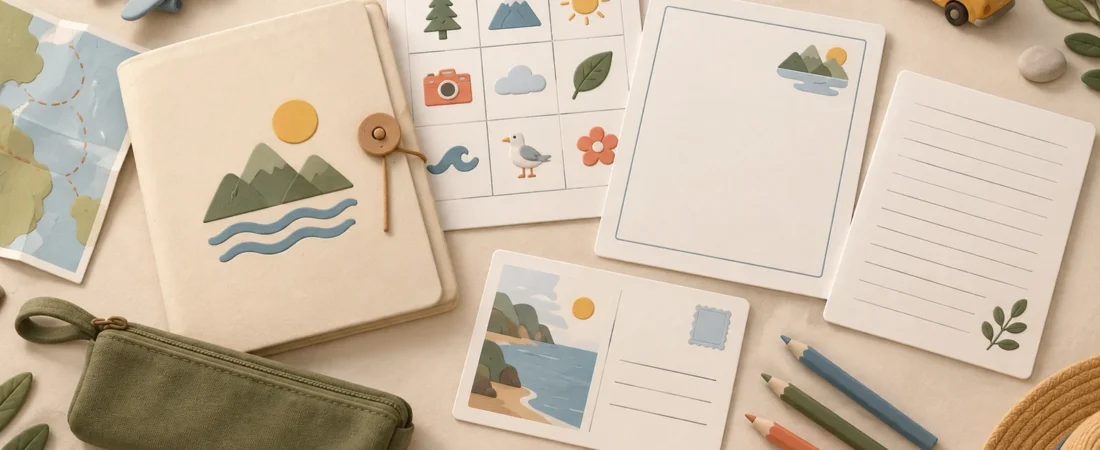
A printable family travel activity pack does not need dozens of pages. A small, well-chosen set is easier to carry, easier to explain and more likely to suit the moments that actually appear during a trip.
The useful question is not “How many activities can we print?” It is “Which page types give this family a few adaptable choices without creating extra work?”
This guide explains a practical pack structure. It does not claim that one format suits every child, and it does not promise educational, developmental, behavioural or screen-use outcomes.
Begin with the trip, not the printer
Before choosing pages, outline the situations in which the pack might be used:
- a passenger journey;
- waiting at a transport terminal;
- a safely parked break;
- a meal stop;
- quiet time at accommodation;
- a museum, attraction or walk, if the current rules allow it; and
- a simple trip recap.
You do not need a separate activity for every situation. The same blank page can support a drawing, a word list, a memory map or a postcard. Adaptable formats keep the pack smaller.
Also check practical constraints. Will there be a stable writing surface? Are loose pencils sensible? Does a venue allow drawing materials? Is the activity for passengers only while a vehicle is moving? Confirm any place-specific rule through the responsible venue or operator instead of assuming that printed activities are welcome everywhere.
Choose a small core of flexible page types
A useful pack can start with five or six page types.
1. An observation page
Create a simple grid for noticing colours, shapes, patterns, movement or sounds. Keep the prompts broad so the page does not depend on a promised animal, landmark, vehicle or attraction.
Useful variations include:
- draw one thing in each category;
- circle a category when something fits;
- add one descriptive word; or
- invent a symbol for each observation.
This page can work from a passenger seat, a window, a safely parked stop or a short walk where current conditions and rules permit.
2. A blank drawing and mapping page
Leave more open space than instructions. A simple title box and a blank area can become:
- a memory map of the last part of the day;
- a sketch of a view;
- an invented route for a story;
- a collection of shapes or patterns; or
- a before-and-after page.
Label any child-created map as a memory or creative activity. It is not navigation guidance and should not replace the route used by the responsible adult.
3. A travel journal page
Use a few neutral prompts rather than a long questionnaire. For example:
- Today I noticed…
- One choice we made was…
- A detail I want to remember is…
- Tomorrow I might…
Leave room for drawing, a short sentence or no response at all. The page should be an option, not a required record of whether the day was enjoyable.
4. A postcard or message page
A postcard template can include one space for an image and one space for a brief message. It can be addressed later, kept in the trip folder or used as a recap.
Avoid preprinting claims about a place. A template that says “Greetings from the best family attraction” becomes inaccurate if plans change and may imply an endorsement the pack cannot support.
5. A story or word-prompt page
Use original, generic prompts such as place, object, character, colour or problem. A traveller can choose one item from each box to build a short story.
Keep prompts independent of a specific destination unless the destination information is verified and the wording is original. Do not copy a museum trail, commercial worksheet, book character or another creator’s activity language.
6. A trip recap page
A recap can collect one drawing, one word, one practical note and one choice for later. It can be completed at a meal stop or at the end of the day rather than during every activity.
The purpose is to make a usable record, not to test memory or require a positive reflection.
Add destination details only when they are current and useful
Generic pages travel well. Destination-specific pages need more care.
If a page names a place, route, facility, opening time, price, wildlife species, cultural detail or access condition, verify that information through the current primary source. Record the check date. Avoid facts that will quickly make the printable stale unless the page tells the user where to recheck them.
A destination page should not imply that a place is suitable for every family. It can present verified information and leave the family to assess fit.
For cultural material, use respectful, well-sourced wording and avoid turning a living culture into a puzzle or decoration. If the pack cannot support the necessary research, keep the prompt general.
Make each page easy to adapt
Adaptability comes from format choices, not from assigning fixed activities by age. Consider:
- one prompt per page instead of a crowded list;
- optional drawing, writing, circling or pointing;
- large open areas and readable type;
- a shared page for several travellers or separate copies when useful;
- a black-and-white design that prints clearly; and
- instructions short enough to understand before the activity begins.
Add complexity only when someone wants it. A basic observation page might ask for one shape; an optional extension could invite a pattern, description or story. Neither version needs to be labelled as the correct level for a particular age.
Keep preparation genuinely low
Every extra page, tool and rule creates packing and explanation work. Use a small kit:
- a slim folder or clipboard;
- a limited number of printed pages;
- pencils or crayons that suit the travel context;
- a few blank cards;
- reusable paper clips or a pouch; and
- spare plain paper.
Avoid materials that are difficult to manage in the intended setting. Loose pieces may be awkward in a moving vehicle. Wet or messy supplies may be unsuitable for transport, accommodation or a venue. Passengers can use activities while a vehicle is moving; the driver should not handle pages, give clues or referee.
Print one test copy before printing the whole pack. Check margins, line weight, text size, writing space and whether a page still makes sense in grayscale.
Organise the pack by moment
Instead of numbering every page as a fixed sequence, group them with simple tabs or icons:
- on the way;
- while waiting;
- at a stop;
- quiet time; and
- remember the day.
This helps the family choose a suitable format without implying that every page must be completed. Put blank paper at the back so a new idea does not require a new template.
For a longer trip, carry only the next few pages and keep replacements with the luggage. A smaller active pack is easier to reset.
Use a simple pack checklist
| Component | Included? | Notes |
|---|---|---|
| Observation page | Broad, non-promissory prompts | |
| Blank drawing or memory-map page | Not for navigation | |
| Journal page | Optional response formats | |
| Postcard/message page | No unverified destination claim | |
| Story/word prompt page | Original wording only | |
| Trip recap page | No required positive outcome | |
| Plain paper | Adaptable backup | |
| Pencils/crayons | Suitable for the setting | |
| Folder or pouch | Easy to repack | |
| Current facts checked | Source and date recorded |
Final review before packing
Check that:
- every activity is optional and easy to stop;
- no page depends on the driver while a vehicle is moving;
- destination facts are current and sourced;
- venue rules have not been assumed;
- the pack uses original wording and artwork;
- no specific outcome is promised;
- pages print clearly; and
- the pack is small enough to organise during the trip.
TripStoryKit’s travel activity books page describes related journal, scavenger-hunt, drawing and printable formats as planned ideas. Review the printables page itself for the latest public position. No particular TripStoryKit pack is represented here as currently available.
The best starting pack is not the biggest one. Choose a few reusable formats, test them, keep destination claims current and leave room for the family to use the pages in its own way.