
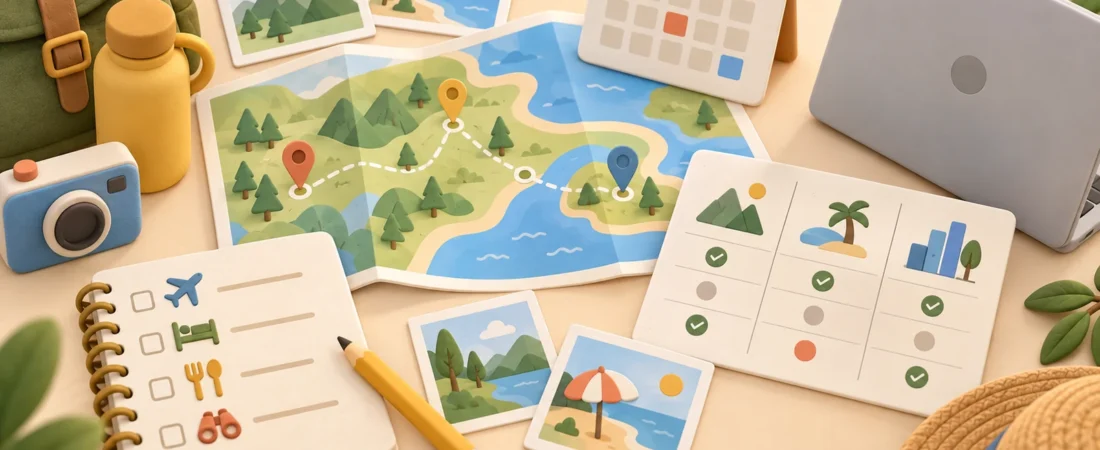
“Family-friendly” is useful as a question, not as a fact to accept from a headline. A destination that works well for one family may create difficult transport, accommodation or timing problems for another.
Research becomes more practical when you stop asking whether the whole destination is family-friendly and start testing a specific trip. Where would the family stay? How would each day work? Which information is official and current? What needs to be booked, and what can remain optional?
TripStoryKit’s method combines reliable destination information with a family-planning layer. It does not assume local or first-hand expertise where none has been supplied.
Define the trip you are researching
Before opening dozens of tabs, write a short trip brief:
- likely dates or season;
- length of stay;
- arrival and departure points;
- people travelling;
- important access, sleeping, food or transport requirements;
- one or two main interests;
- preferred pace; and
- the family’s own budget boundary.
Keep unknowns marked as unknown. If dates are not fixed, do not research one week’s timetable as though it will apply to the eventual trip.
The brief prevents generic “best destination” lists from deciding the plan. It gives you a set of requirements against which current information can be tested.
Build an official-source map
Create a small list of primary sources before reading commentary and reviews. Depending on the trip, that list may include:
- the destination country’s immigration or border authority;
- the relevant government travel-advisory service;
- official airport, rail, ferry or public-transport operators;
- national or local road authorities;
- the official weather service;
- local authorities or park agencies;
- the accommodation provider;
- the official page for an essential attraction or event; and
- an official destination organisation for general orientation.
For New Zealanders travelling overseas, SafeTravel’s Before you go guidance is one government starting point. Its current page directs travellers to research and preparation and links to advice covering matters such as passports, visas and travel insurance. Readers from elsewhere should use the relevant authority for their own citizenship and circumstances.
Record the source, URL, date checked and what decision it supports. Do not copy a fact into the itinerary without keeping its source.
Verify entry and travel requirements separately
Entry conditions can depend on citizenship, passport, trip purpose, length of stay and other details. Use the responsible government authority, not a blog summary, to identify the current requirements that apply to the travellers.
Keep the research task separate from the final decision. If the official information is unclear for the family’s circumstances, the article cannot resolve it. Seek the appropriate official or professional guidance before paying for a non-refundable booking.
Avoid turning a current rule into evergreen article copy. Link to the authority and recheck near booking and departure.
Map the arrival-to-accommodation journey
An accommodation listing can look convenient without showing how the family will reach it.
Research the actual chain:
- arrival terminal or station;
- border, baggage or vehicle-collection steps that apply;
- transport from the arrival point;
- transfers, walking sections or pickup arrangements;
- check-in conditions; and
- access to food and the first essential stop.
Use current operator information for timetables, stops, luggage conditions and service notices. Mark anything not yet verified.
Do not label a transfer “easy” simply because a map shows a short distance. The useful question is whether the full transfer works for this family with its luggage, timing and chosen mode.
Test the accommodation location against real days
Price and room features are only part of an accommodation decision. Put the location into two or three realistic day plans.
Check:
- time and complexity to reach priority areas;
- number of daily transfers;
- current operating windows for transport the family would rely on;
- options for meals and essential supplies;
- the accommodation’s own check-in, occupancy and facility information; and
- the consequence if the family returns earlier than planned.
A central location is not automatically best. A quieter or less central location may suit one plan; it may create repeated transport work in another. Compare the location with the itinerary, not with a general label.
Build one realistic sample day
Choose one likely day and put it on a timeline. Include:
- getting ready;
- travel to the first stop;
- meals and toilets;
- entry or queue time where verified;
- transitions between activities;
- a lower-demand or indoor alternative;
- travel back; and
- any fixed booking.
Do not use the sample day to prove that everything fits. Use it to expose hidden transport and transition costs.
If the sample requires every connection to run perfectly, several fixed activities or an exact weather outcome, simplify it. A destination may still fit, but the current version of the day does not.
Treat activities as a mix, not a checklist
Research a small range of formats:
- one priority experience;
- flexible outdoor choices;
- indoor or lower-demand options;
- simple neighbourhood or accommodation time; and
- activities that require no advance payment.
For each essential activity, use its current primary page to check booking rules, operating dates, location, access information and restrictions. Do not infer suitability from the word “family” in marketing copy.
Optional activities do not all need full research before booking the trip. Record where to verify them later and keep them out of the fixed schedule until the information is current.
Check current transport, access and conditions at the right time
Some research belongs early; some belongs close to travel.
Before booking
- entry and passport requirements relevant to the travellers;
- whether the main route and accommodation location are workable;
- major seasonal or operating constraints;
- essential booking conditions; and
- the current total cost and cancellation terms of contemplated purchases.
After booking but before travel
- timetable changes;
- provider instructions;
- local transport notices;
- current access information; and
- any updated government advice.
Near each travel day
- live weather and warnings;
- current road or transport disruption;
- same-day operating information; and
- the primary page for any specific place.
This timing keeps live facts out of an evergreen plan while making the recheck responsibility explicit.
Separate evidence from interpretation
Use two columns in your notes.
| Observed from a current source | What it may mean for this family |
|---|---|
| Timetable shows a transfer | Decide whether that transfer suits luggage and timing |
| Provider lists a booking window | Add the confirmed window to the day plan |
| Accommodation gives a check-in condition | Test arrival options against it |
| Official page lists an access restriction | Decide whether another option is needed |
| Weather service publishes a current warning | Reassess the day using the latest official advice |
The first column is evidence. The second is planning interpretation. Keeping them separate prevents a personal preference from being written as a destination fact.
Use reviews for questions, not final authority
Recent reviews and traveller discussions can surface questions that official pages do not answer clearly. They may mention noise, confusing transfers, queue patterns or practical room details.
Treat those accounts as prompts to verify, not proof that every visitor will have the same experience. For important facts, return to the responsible provider or authority. Keep the date and context of any subjective report you retain.
Avoid copying another writer’s itinerary or distinctive activity structure into your own guide. Research can inform the questions; the final planning method and wording should remain original.
Create a pre-booking decision sheet
| Decision | Evidence/source | Checked | Status |
|---|---|---|---|
| Entry requirements for these travellers | Verified / unresolved | ||
| Arrival-to-accommodation route | Workable / revise | ||
| Accommodation location tested against sample days | Pass / compare | ||
| Essential transport operating information | Verified / recheck | ||
| One realistic sample day | Workable / simplify | ||
| Priority activity terms and access | Verified / unresolved | ||
| Lower-demand or weather alternative | Identified / missing | ||
| Current total and booking terms | Verified / compare | ||
| Release-time recheck list | Recorded / missing |
Do not convert an unresolved item into a reassuring assumption. If it could materially affect the booking, resolve it or choose a plan that does not depend on it.
Final decision: fit, not label
Before booking, ask:
- Does the destination fit the trip brief?
- Can the family reach and use the accommodation without an unrealistic chain of transfers?
- Does a sample day leave room for meals, toilets and normal changes?
- Are essential facts supported by current primary sources?
- Are optional activities genuinely optional?
- Is there a workable alternative if one plan changes?
- Which facts need another check before departure?
TripStoryKit’s destination planning and family travel planning pages provide broader context. Their role is to help turn reliable information into a usable family plan, not to declare that every destination suits every family.
Research is complete enough to book when the important constraints are supported, the daily structure is credible and the unresolved questions are either minor or deliberately removed from the plan.